


The Research Bottleneck Has Moved. It Is Time Analysis Caught Up.
09 June 2026
 Share
Share

Authored by Matteo Cera, CEO & Co-Founder of Glaut
Matteo Cera is the CEO and co-founder of Glaut, an AI-native Market Research Platform for experienced researchers. Since 2023, Glaut has pioneered AIMIs, a hybrid data collection methodology based on AI-moderated voice interviews, in +50 languages. Glaut software allows researchers to program and run large-scale research projects, and analyze qual insights at scale. With over 15 years experience in tech, Matteo began his career at McKinsey & Company and graduated summa cum laude in Business & Law from Bocconi University.
Over the last few years, the research industry has spent considerable energy rethinking data collection.
That made sense. Better respondent experiences, richer open-ended answers, faster fieldwork, and more flexible ways of reaching people have all changed what research teams can collect.
But for research operations teams, this has created a new pressure point.
The bottleneck has moved to analysis.
For many teams, the hardest part of a project now begins when fieldwork closes. The data is in. The client is waiting. The team has days, sometimes hours, to turn responses, sample cuts, open ends, tables, and late stakeholder questions into something coherent, useful, and defensible.
When fieldwork ends, the real pressure begins
Analysis is often where the grunt work starts.
- Moving files between platforms.
- Cleaning exports.
- Rebuilding crosstabs with new filters.
- Coding open-ended responses.
- Pulling verbatim.
- Turning numbers into charts.
- Updating slides after a late client question.
- Checking whether a claim still holds once the sample is split differently.
None of this is marginal work. It is necessary. But it takes time away from the part of research that clients actually pay for: judgment.
Today, analysis often happens across a fragmented stack: one tool for survey data, another for open ends, another for tables, another for charts, and another for the final deck.
Each handover creates more work. Every manual transfer creates more room for errors. And every late change forces the team to check again which data source, filter, coding frame, or version is being used.
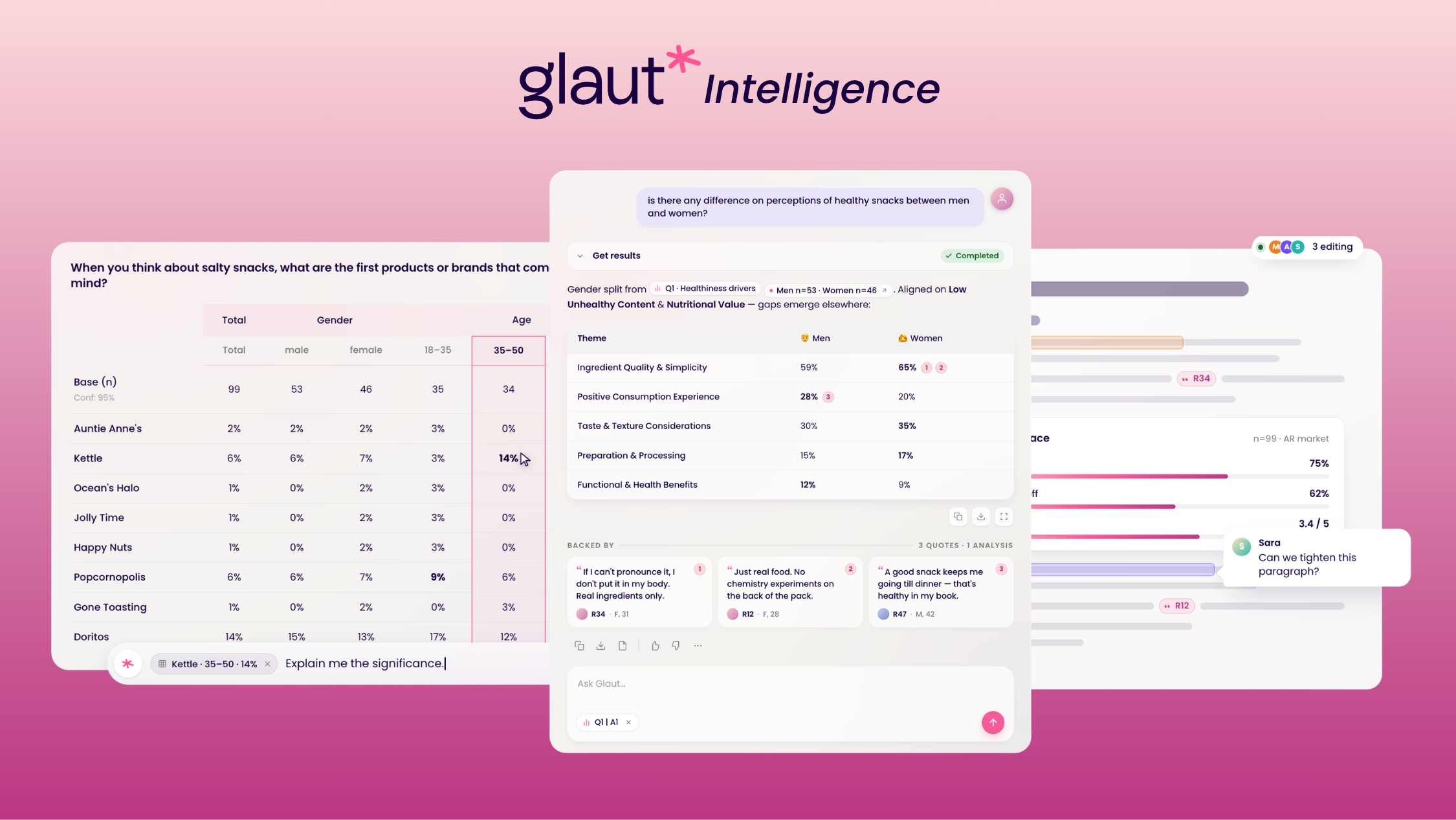
That is the problem Glaut Intelligence was built to address.
The answer cannot be another ‘AI black box.’
The answer cannot be a black box.
Research teams do not need analysis outputs that they cannot interrogate. They need to know where each chart came from, which source data was used, which filters were applied, which verbatim statements support each claim, how open-ended responses were coded, and what changed between versions.
That is why the future of research analysis should not be framed as full automation. It should be framed as a better division of labor.
Glaut Intelligence handles the grunt work of analysis: structuring the analysis plan, coding open-ended responses, generating tables, surfacing patterns, testing hypotheses, and drafting a working report.
The researcher remains responsible for the judgment layer: checking the evidence, applying context, deciding what counts as a finding, and shaping the final client narrative.
This distinction matters because research analysis is not only about producing outputs. It is about being able to defend how those outputs were produced.
Glaut Intelligence gives researchers time back for judgment.
A useful analysis system should not try to remove the researcher from the process. It should give them more time to think.
That is also why auditability is central. Every data point should trace back to its source. Every claim should be open to review. Every coding decision should be editable. Different versions of a report should be visible, not lost in a chain of files named “final_v7_real_final”.
In practical terms, this changes the rhythm of a project.
Instead of starting from a blank page after fieldwork closes, researchers can start from an approved analysis plan. Instead of rebuilding tables manually each time a new question comes in, they can interrogate the same dataset directly. Instead of treating open-ended responses as a separate appendix, they can incorporate them into the broader evidence base.
The goal is not to make research feel less human. It is to make the human part easier to protect.
The best researchers are not valuable because they can copy tables into slides faster than anyone else. They are valuable because they can understand what a client is really asking, separate signal from noise, challenge a weak interpretation, and turn evidence into a clear recommendation.
When analysis workflows are slow, fragmented, and hard to audit, that value gets squeezed into the margins. When the grunt work is compressed, researchers get time back for the work that moves the project forward.
That is the principle behind Glaut Intelligence: faster analysis while the researcher remains in control.
We are opening early access to the platform for the MRS Operations Network. If you want to try it first, get 1 month of free access here.
More operations newsletters
Get the latest MRS news
Our newsletters cover the latest MRS events, policy updates and research news.









©2026 The Market Research Society,
15 Northburgh Street, London, UK EC1V 0JR
Tel: +44 (0)20 7490 4911 Email: info@mrs.org.uk
The Market Research Society (MRS) is the world's leading research association. For all those who need, generate or interpret the evidence for making good business and policy decisions. Click here to find out more about us.
©2026 The Market Research Society,
15 Northburgh Street, London EC1V 0JR
Tel: +44 (0)20 7490 4911 Email: info@mrs.org.uk
0 comments