


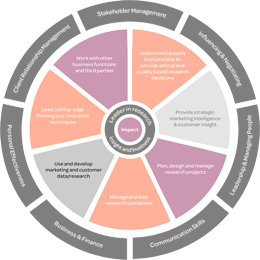
Use and develop marketing and customer data/research
Training
Global Insight Academy
Training
On-demand
Bespoke company training
Qualifications
CPD
Resources
Accreditation
- MRS Qualifcations accredited centre area
- List of MRS Qualification accredited centres
- Become an MRS Qualification accredited centre
- Accredited CPD training providers
- Recruiter Accreditation Scheme/Recruiter Training Programme
- Register of RAS Accredited Recruiters
- Register of Recruiter Accredited Companies
- RAS - FAQs
Mentoring
Apprenticeships
ESRC PhD Placements
 Share
Share
With the evolution of ‘big data’ managing business intelligence can mean dealing with a variety of information sources: customer databases, external data sources and research results. Integrating these streams of insight and intelligence can expose new understanding and strategic direction to provide deeper levels of insight and intelligence for your organisation or client.
Knowledge, Skills and Attitudes
1. Understand and apply appropriate data collection methodology(s) using research techniques, internal or external data sources, etc
2. Understand and establish relevant data protocols, understand client data needs, implementing relevant data legislation (e.g. Data Protection Act 1998) and/or quality requirements
3. Evaluate and select appropriate quantitative or qualitative data collection tools
4. Understand and apply quantitative statistical and data modelling techniques and/or qualitative techniques
5. Understand and apply data and/or customer segmentation techniques
6. Understand and apply data techniques for the analysis and interpretation of multiple data sets and/or data sources
7. Understand and deploy appropriate techniques for the interpretation of findings e.g. visualisation, storytelling, etc.
Essentials of Quantitative Research
Virtual training course
Data collection, sampling, analysis, presentation.
Story Techniques to Support Strategic Thinking
London
Enhance your ability to think and write more strategically by applying storytelling techniques that will inspire your audience to act.
Statistical Methods Masterclass
Virtual training course
Multivariate and other statistical techniques for use in research.
Get the latest MRS news
Our newsletters cover the latest MRS events, policy updates and research news.






©2026 The Market Research Society,
15 Northburgh Street, London, UK EC1V 0JR
Tel: +44 (0)20 7490 4911 Email: info@mrs.org.uk
The Market Research Society (MRS) is the world's leading research association. For all those who need, generate or interpret the evidence for making good business and policy decisions. Click here to find out more about us.
©2026 The Market Research Society,
15 Northburgh Street, London EC1V 0JR
Tel: +44 (0)20 7490 4911 Email: info@mrs.org.uk